

How To Auto Login Windows Xp
SMB Stands for "Server Message Block." SMB is a network protocol used by Windows-based computers that allows systems within the aforementioned network to share files. It allows computers connected to the same network or domain to access files from other local computers as easily as if they were on the computer's local hard drive.
Not only does SMB permit computers to share files, but it as well enables computers to share printers and fifty-fifty serial ports from other computers within the network. For instance, a estimator connected to a Windows network could print a document on a printer connected to some other computer on the network, equally long every bit both machines support the SMB protocol.
Though SMB was originally developed for Windows, information technology tin can also be used by other platforms, including Unix and Os X, using a software implementation called Samba. By using Samba instructions, Mac, Windows, and Unix computers can share the aforementioned files, folders, and printers.
SMB Versions
There are several different versions of SMB used by Windows operating systems:
- CIFS – The ancient version of SMB that was office of Microsoft Windows NT iv.0 in 1996. SMB1 supersedes this version.
- SMB 1.0 (or SMB1) – The version used in Windows 2000, Windows XP, Windows Server 2003 and Windows Server 2003 R2
- SMB 2.1 (or SMB2.one) – The version used in Windows 7
- SMB iii.0 (or SMB3) – The version used in Windows 8 and Windows Server 2012
SMB Negotiated Version
Hither's a tabular array to aid you understand what version you will end upward using, depending on what Windows version is running as the SMB customer and what version of Windows is running every bit the SMB server:
| Customer / Server Bone | Windows eight | Windows 7 | Previous versions |
| Windows 8 | SMB 3.0 | SMB 2.1 | SMB i.0 |
| Windows 7 | SMB two.1 | SMB 2.1 | SMB ane.0 |
| Previous versions | SMB 1.0 | SMB 1.0 | SMB 1.0 |
Features and Capabilities
Here's a very short summary of what changed with each version of SMB:
- From SMB i.0 to SMB 2.0 - The starting time major redesign of SMB.
- Increased file sharing scalability
- Improved Performance
- Asking Compounding
- Asynchronous Operations
- Larger reads/writes
- More Secure and Robust
- Small control set
- Signing now uses HMAC SHA-256 instead of MD5
- SMB2 durability
- From SMB 2.0 to SMB 2.1
- File leasing improvements
- Large MTU support
- BranchCache
- From SMB 2.1 to SMB 3.0
- Availability
- SMB Transparent Failover
- SMB Witness
- SMB Multichannel
- Performance
- SMB Scale-Out
- SMB Direct (SMB three.0 over RDMA)
- SMB Multichannel
- Directory Leasing
- BranchCache V2
- Backup
- VSS for Remote File Shares
- Security
- SMB Encryption using AES-CCM (Optional)
- Signing now uses AES-CMAC
- Management
- SMB PowerShell
- Improved Performance Counters
- Improved Eventing
- Availability
How does SMB work?
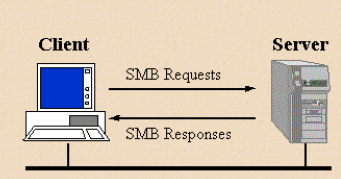
The diagram shows the fashion in which SMB works. Clients connect to servers using TCP/IP. Servers make file systems and other resources (printers, mailslots, named pipes, APIs) available to clients on the network. Client computers may have their own hard disks, only they besides want admission to the shared file systems and printers on the servers.
Clients connect to servers using TCP/IP (protocol). In one case they have established a connexion, clients tin can then send commands (SMBs) to the server that permit them to access shares, open up files, read and write files, and mostly do all the sort of things that y'all want to practice with a file arrangement. Nonetheless, in the case of SMB, these things are done over the network.
How SMB impacts functioning?
The following table will explain how SMB creates Impact on Functioning. The version of SMB used for file sharing is determined during the SMB session negotiation. If both the customer and server support SMB 2.0, and then SMB 2.0 is selected during the initial negotiation. Otherwise, SMB i.0 used for preserving backwards compatibility.
Below test was conducted to check the effect on performance.
| Client | Server | SMB Negotiated Version | Result on performance |
| Win XP | Win 7/win 2008 server | SMB1 | No result |
| Win seven, Win 2008 server, win xp | Win XP | SMB1 | No upshot |
| Win 7, winxp | Win 2008 server/win vii | SMB2, SMB1 | Performance effected when beginning communication is between smb2 to smb2. Operation not effected when offset communication is between smb1 and smb1. |
Performance Tests
Test 1: Test using Notepad
Testing was done by creating a notepad in the shared folder on Win 2008 server. Here the communication happens through smb2 protocol. This can be observed using the Microsoft Network Monitor. (See the highlighted line).
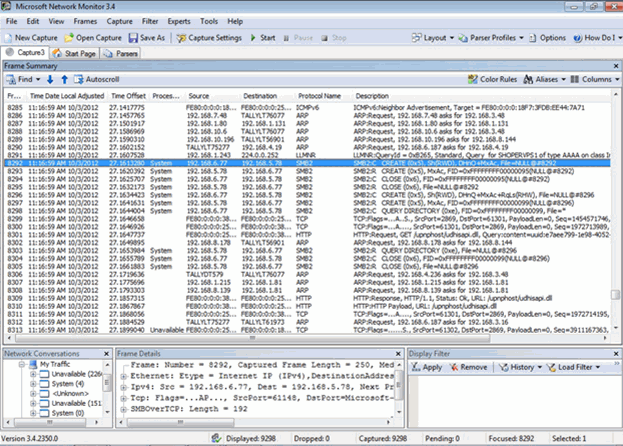
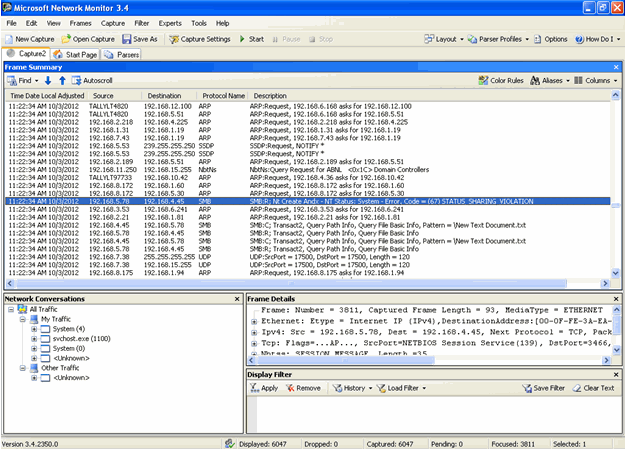
Afterwards creating the notepad from Windows 7 endeavour to delete the same from Win XP motorcar immediately(less than few seconds). On trying to delete, system prompts error message as shown below.

The same tin as well exist observed using the Network monitor, where it shows a Sharing Violation. (Run into the highlighted line).
Reason
- Client (Windows 7) sends Request to server to Create File via SMB2 (check in Fig ane)
- Server Responses to let creation for client via SMB2
- Afterwards Creation, Client (windows 7) sends request to shut SMB2 for the new file created. To sends this request there is a fourth dimension delay.
- During this delay, if some other asking comes from SMB1 for accessing the same file then sharing violation error shown. If it is same version of SMB, and so able to access the file.
When higher version named piping is non airtight and if request comes from lower version and so sharing violation occurs. When lower version client is continuously attempting to access the file then sharing violation happens multiple times. This ultimately impacts the performance of client.
Test 2: Select Company > Display Company Login Screen in Tally.
Testing was done by sharing Tally data folder on win 2008 server. Tally application was opened on window 7 and company was selected to display the Login Screen. During this procedure the SMB2 protocol is used to communicate with the windows server 2008 machine.
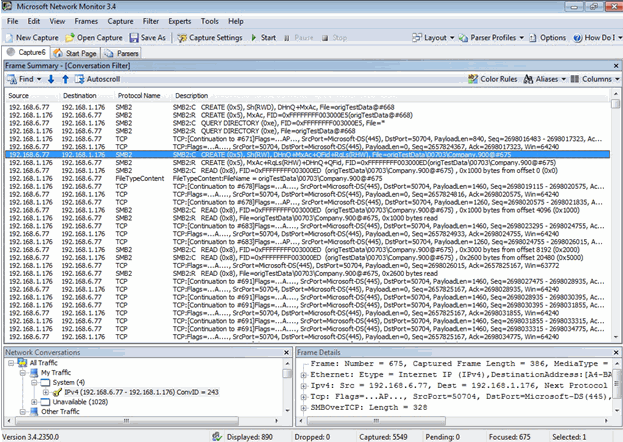
And so the same data was accessed past WinXP via SMB Protocol. From the Win XP customer, to display the Login screen of the aforementioned Company, it is taking fourth dimension.
In the Network Monitor, it is continuously showing sharing violation in TAccess.tsf file.
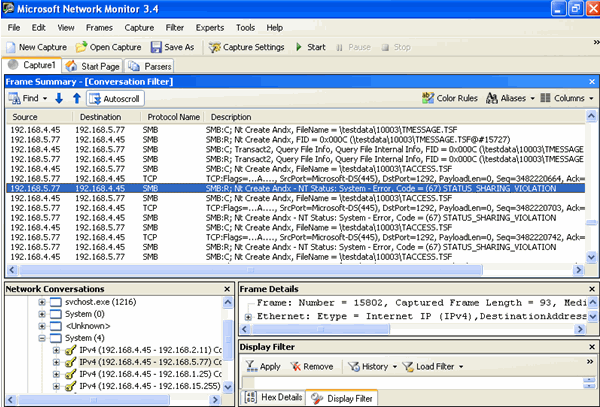
Reason
- Client (Windows seven) sends Request to server to Create TAccess.tsf File via SMB2
- Server Responses to allow creation for client via SMB2
- After Creation, Customer (windows 7) sends request to close SMB2 for TAccess.tsf file. To sends this request there is a time delay.
- During this delay time, Windows XP sends asking to server for cosmos of TAccess.tsf file. Since SMB2 namedpipe is not airtight for TAccess.tsf file in Windows 7 customer, it is showing sharing violation in WinXP client.
Tally Awarding in WinXP customer will wait until it gains admission to the TAccess.tsf file. This look time impacts functioning.
Decision
From the tests, nosotros tin conclude that in a sharing environment, the operation will be impacted when data server is in higher SMB version and Clients are in both higher and lower SMB Versions.
Recommendation
Selection one
- Data Server – SMB1 Version OS
- Clients – (SMB 1 or higher Version Bone)
- As Data server is in SMB1, advice will happen in SMB1 only.
Selection two
- Data Server – SMB2 Version OS
- Clients – (SMB ii or higher Version Bone)
- Equally Data Server is in SMB2, Advice will happen in SMB2 Merely.
Option iii
- Data Server – SMB3 Version Bone
- Clients – (SMB 3 or college Version Os)
- As Data Server is in SMB3, Advice will happen in SMB3 Only.
Source: https://help.tallysolutions.com/tally-prime/data-management/data-sharing-in-windows-faq/
Posted by: gentryshom1981.blogspot.com
0 Response to "How To Auto Login Windows Xp"
Post a Comment